My Resume
Education
PhD in Astrophysics and Space Science
2018 - 2024
Affiliation: Center of Excellence in Space Sciences India (CESSI), Indian Institute of Science Education and Research (IISER) Kolkata, Mohanpur, India
CGPA (Course Work): 9.38/10.00
Supervisor: Prof. Dibyendu Nandi
Thesis: Modeling the Impact of Space Weather on Planetary Space Environments.
Masters in Physics
2015 - 2017
Affiliation: West Bengal State University, Barasat, India
CGPA: 5.13/6.00
Specialization: Astrophysics, Cosmology, Computational Physics, High Energy Physics
MSc Thesis: Accretion properties of rotating naked singularities and the generalised pseudo-Newtonian potential for studying accretion disk dynamics of rotating naked singularities.
Advisor: Prof. Parthasarathi Joarder
Institute: Centre for Astroparticle Physics & Space Sciences, Bose Institute, Kolkata, India
Bachelors in Physics (Honours)
2012 - 2015
Affiliation: Rishi Bankim Chandra College, Naihati, India
University: West Bengal State University
Marks: 72.38% (First Class)
Teaching Experience
Teaching Assistant
2020 - 2022
Organization: Indian Institute of Science Education and Research (IISER) Kolkata
Subjects:
- Intermediate Electricity Magnetism (PH3202)
- Instructor: Prof. Rajesh Kumble Nayak
- Spring 2020
- Introductory Astrophysics (PH4102)
- Instructor: Prof. Dibyendu Nandi
- Autumn 2020
- Autumn 2021
- Autumn 2022
- Fluid and Magnetohydrodynamics (SS4201)
- Instructor: Prof. Dibyendu Nandi
- Spring 2021
- Spring 2022
Assistant Teacher
2017 - 2018
Organization: Idrakpur Primary School, Nadia District Primary School Council, Government of West Bengal
Skills & Languages
For Communication
English
Bangla (Bengali) - বাংলা
Hindi - हिन्दी
Spanish - español
Expertise
Astrophysics and Fluid Dynamics
Computational Magnetohydrodynamics
High Performance Computing
Sattelite Data Analysis
Image Analysis
Data Visualisation
Coordinate Geometry
Skills & Languages
For Programming
Python
Matlab
C
Fortran
MAGE (Software)
PLUTO (Software)
Linux/Bash
Latex and basic Office tools
VisIt (Software)
Paraview (Software)
Kdenlive (Software)
10+
Research Articles and Proceedings
20+
Conferences and Workshops Attended
12+
Achievements and Awards
6+
Teaching Assistantship
Notable Works
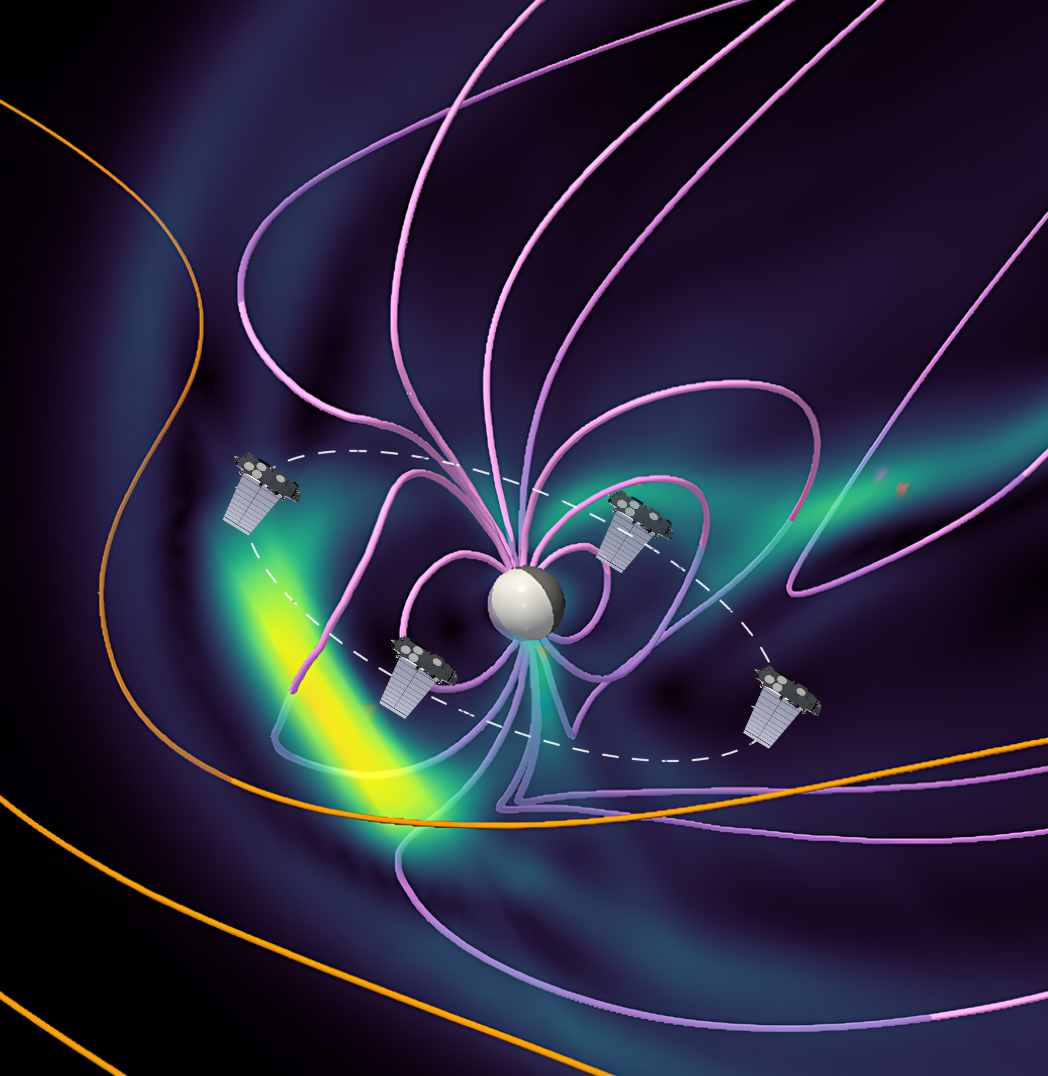
The loss of Starlink satellites in February 2022: How moderate geomagnetic storms can adversely affect assets in low‐earth orbit
Authors: Yoshita Baruah, Souvik Roy, Suvadip Sinha, Erika Palmerio, Sanchita Pal, Denny M Oliveira, Dibyendu Nandy
Journal: Space Weather, Volume: 22, Issue: 4, Pages: e2023SW003716
DOI: 10.1029/2023SW003716
Abstract: On 3 February 2022, SpaceX launched 49 Starlink satellites, 38 of which unexpectedly de-orbited. Although this event was attributed to space weather, definitive causality remained elusive because space weather conditions were not extreme. In this study, we identify solar sources of the interplanetary coronal mass ejections that were responsible for the geomagnetic storms around the time of launch of the Starlink satellites and for the first time, investigate their impact on Earth's magnetosphere using magnetohydrodynamic modeling. The model results demonstrate that the satellites were launched into an already disturbed space environment that persisted over several days. However, on performing comparative satellite orbital decay analyses, we find that space weather alone was not responsible but conspired together with a low-altitude insertion and low satellite mass-to-area ratio to precipitate this unusual loss. Our work bridges space weather causality across the Sun–Earth system—with relevance for space-based human technologies.
Read more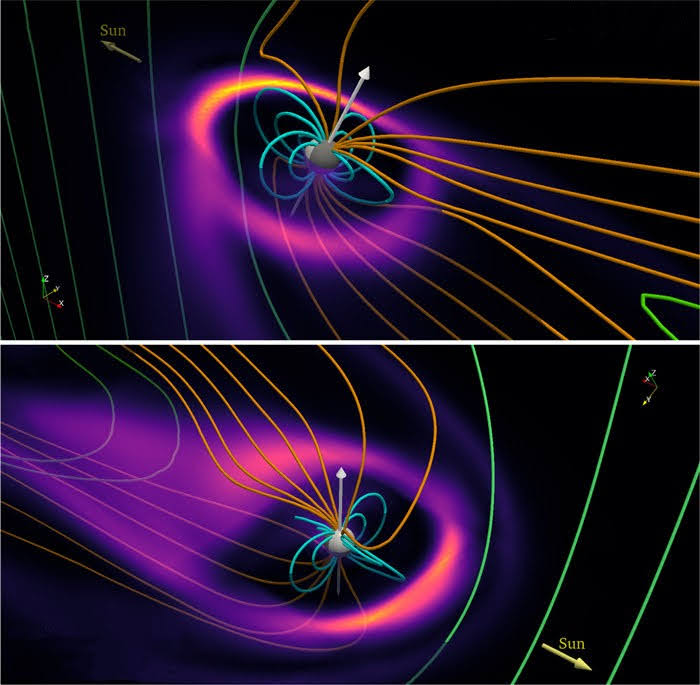
A Time-efficient, Data-driven Modeling Approach for Predicting the Geomagnetic Impact of Coronal Mass Ejections
Authors: Souvik Roy and Dibyendu Nandi
Journal: The Astrophysical Journal Letters, Volume: 950, Issue: 2, Pages: L11
DOI: 10.3847/2041-8213/acd77c
Abstract: To understand the global-scale physical processes behind coronal mass ejection (CME)–driven geomagnetic storms and predict their intensity as a space weather forecasting measure, we develop an interplanetary CME flux rope–magnetosphere interaction module using 3D magnetohydrodynamics. The simulations adequately describe CME-forced dynamics of the magnetosphere including the imposed magnetotail torsion. These interactions also result in induced currents, which are used to calculate the geomagnetic perturbation. Through a suitable calibration, we estimate a proxy of geoeffectiveness—the Storm Intensity index (STORMI)—that compares well with the Dst/SYM-H index. Simulated impacts of two contrasting CMEs quantified by the STORMI index exhibit a high linear correlation with the corresponding Dst and SYM-H indices. Our approach is relatively simple, has fewer parameters to be fine-tuned, and is time efficient compared to complex fluid-kinetic methods. Furthermore, we demonstrate that flux rope erosion does not significantly affect our results. Thus our method has the potential to significantly extend the time window for predictability—an outstanding challenge in geospace environment forecasting—if early predictions of near-Earth CME flux rope structures based on near-Sun observations are available as inputs. This study paves the way for early warnings based on operational predictions of CME-driven geomagnetic storms.
Read more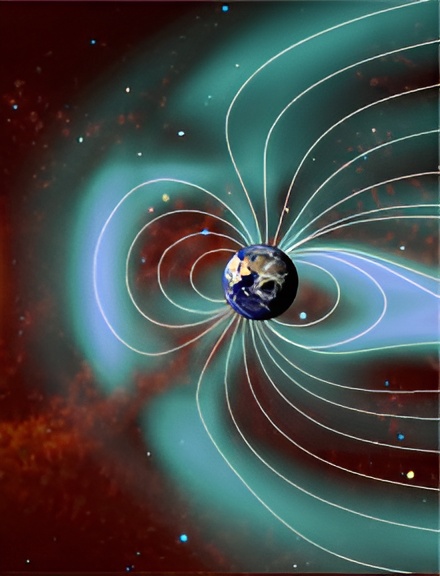
Causality in heliophysics: Magnetic fields as a bridge between the Sun’s interior and the Earth’s space environment
Authors: Dibyendu Nandy, Yoshita Baruah, Prantika Bhowmik, Soumyaranjan Dash, Sakshi Gupta, Soumitra Hazra, B Lekshmi, Sanchita Pal, Shaonwita Pal, Souvik Roy, Chitradeep Saha, Suvadip Sinha
Journal: Journal of Atmospheric and Solar-Terrestrial Physics, Pages: 106081
DOI: 10.1016/j.jastp.2023.106081
Abstract: Our host star, the Sun, is a middle-aged main sequence G type star whose activity varies. These variations are primarily governed by solar magnetic fields which are produced in the Sun’s interior via a magnetohydrodynamic dynamo mechanism. Solar activity manifests across different timescales, spanning transient phenomena such as flares, energetic particle events and coronal mass ejections to short to long-term modulation of solar irradiance, plasma winds, open flux and cosmic ray flux in the heliosphere. Collectively, these phenomena define space weather and space climate, which impact the state of the near-Earth space environment, the Earth’s magnetosphere, atmosphere and our space-reliant technologies. Understanding physical processes that are at the heart of solar variability and which causally connect the Sun–Earth system is therefore of immense importance to humanity. Such understanding leads to predictions of the impact of solar activity on our planet and provides a window to explore the plasma universe and other star–planet systems, including assessing the habitability of (exo)planets. In this review, based on our research on the solar–terrestrial system and extant scientific literature, we illuminate processes related to the genesis of solar magnetic fields in the Sun’s interior, their emergence and evolution, their manifestation as solar eruptive events, and their eventual impact on the geospace environment mediated via solar winds and storms. We focus on few phenomena that establish causal connections and demonstrate how our current understanding can lead to development of predictive capabilities encompassing the domain of heliophysics.
Read moreসহজ কথা, সহজ করে, বলি না তো সহজে!
বলি তারে কঠিন করে, যাতে ঢোকে মগজে..
Recent Conferences and Workshops
20th European Space Weather Week
November 2024
Contributed Poster
19th European Space Weather Week
November 2023
Contributed Talk
4th Eddy Cross-Disciplinary Symposium
October 2023
Contributed Talk
UK Space Weather and Space Environment Meeting
September 2023
Contributed Talk
Fourth Aditya L1 Support Cell Workshop 2023
July 2023
Invited Talk
European Geosciences Union (EGU) General Assembly 2023
April 2023
USO-PRL Solar Physics Workshop (USPW-2023)
April 2023
Solicited Talk
41th Annual Meeting of the Astronomical Society of India
March 2023
Contributed Talk
NASA Heliophysics Science Division (HSD) Seminar
January 2023
Invited Talk
NASA Heliophysics Summer School 2022
August 2023
Online Attendee
40th Annual Meeting of the Astronomical Society of India
March 2022
Contributed Poster
15th Quadrennial Solar-Terrestrial Physics symposium
February 2022
Contributed Talk
21st National Space Science Symposium (NSSS - 2022)
January 2022
Contributed Talk
মুখ ঢেকেছি বিজ্ঞাপনে, রেখেছি তবু খুব যতনে
মনের নরমখানি।
সহজ, কিন্তু জটিল ভারী! এড়িয়ে বাঁচা ঝকমারী —
হাসির হাতছানি।
Awards and Achivements
Senior Research Fellowship from Council of Scientific & Industrial Research (CSIR)
2020
Junior Research Fellowship from Council of Scientific & Industrial Research (CSIR), June 2017
2018
West Bengal Government Swami Vivekananda Merit cum Means (SVMCM) Scholarship
2015 - 2017
2nd Rank Holder in M.Sc in Physics in West Bengal State University
2017
Avik Mukherjee Memorial Award, Rishi Bankim Chandra College, (College Topper in Honours)
2015
10th Rank Holder in B.Sc in Physics in West Bengal State University
2015
Rishi Bankim Medha Puroshkar (Topper in B.Sc Honours)
2015
Rishi Bankim Chandra College Award (Topper Physics Honours)
2015
Nagendra Nath Pal Memorial Award (Topper Physics Honours)
2015
Indian Oil (IOCL) Scholarship For Higher Secondary Studies
2010 - 2012
West Bengal Government Merit Cum Means Scholarship
2010 - 2012
West Bengal Government Merit Cum Means Scholarship
2008 - 2010
ফেরার তাড়া ছিল, তারা দেখা হয়নি তার
কি জানি, কোনদিনও, সুযোগ হবে কি আর!
আড়িতেই ছুঁয়ে ছিল, সেটুকুই থাক তবে।
স্মৃতির পাতাই সই, মোলাকাৎ ধবধবে!
Authentic and Simulated Moments
Get in touch
Telehone :
+1 (310) ZLI-OG-16; +91 (WRE) DL-130-RL
Address :
520 Portola Plaza,
Los Angeles, CA 90095, USA
Email :
souvik[at]atmos[dot]ucla[dot]edu
mail2me[dot]souvik[at]gmail[dot]com
Quick links
- UCLA Department of Atmospheric and Oceanic Sciences
- NASA DRIVE Science Center for Geospace Storms (CGS)
- MAGE (Kaiju) GitHub Repository
- Center of Excellence in Space Sciences India (CESSI)
- Indian Institute of Science Education and Research (IISER) Kolkata
- Prof. Dibyendu Nandi
- Prof. Roger Varney
- My Ph.D. Thesis